


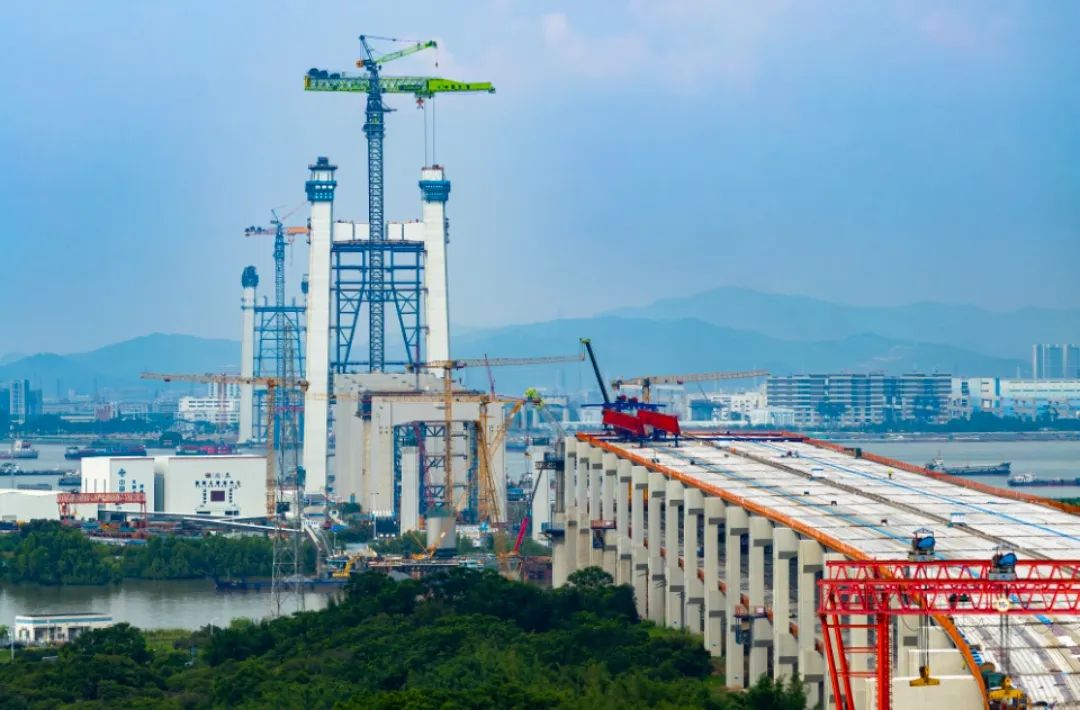
On July 29, construction of the world's longest double-decker suspension bridge, the Shiziyang Bridge, achieved a major milestone. The eastern tower completed the hoisting of its 32nd steel shell segment, bringing both towers to a height of 171.1 meters, more than halfway to their full height of 342 meters. This progress lays the foundation for full tower completion in early 2026.
Spanning the Pearl River, the Shiziyang Corridor is a key transportation project in the Guangdong-Hong Kong-Macao Greater Bay Area (GBA). It links Nansha District of Guangzhou with Humen Town in Dongguan, connecting major highways: the newly opened Guangzhou–Zhongshan–Jiangmen Expressway in the west and the Changping–Humen Expressway in the east. Designed as a 16-lane, double-decker highway, the project will significantly enhance east-west mobility across the Pearl River Delta.
Its centerpiece, the Shiziyang Bridge, is the world's largest double-decker suspension bridge. With a central span of 2,180 meters and towers rising to 342 meters, equivalent to a 110-story skyscraper, the bridge is set to break multiple world records. These include the longest main span, tallest suspension towers, largest anchorage foundation, most extensive main cable system, and highest number of lanes for a suspension bridge.
Built by CCCC Second Harbor Engineering and Poly Changda, the bridge uses an innovative steel-concrete composite tower system made of 62 steel segments and six cross beams per tower.
Beyond the main bridge, construction is advancing rapidly across the entire Shiziyang Channel. On the same day as the tower milestone, construction officially began on a key connector project between the Shiziyang Channel and the Guangzhou–Zhongshan–Jiangmen Expressway by widening the Nansha-Zhongshan Bridge from six to eight lanes to match the Shiziyang Bridge's upper level. This marks the world's first widening of a central-cable concrete cable-stayed bridge, overcoming unprecedented technical challenges in structure coordination, materials, and construction methods.
Once completed, this superstructure will ease pressure on the overburdened Humen and Nansha Bridges, reduce travel times across the Pearl River, accelerating development of the GBA.